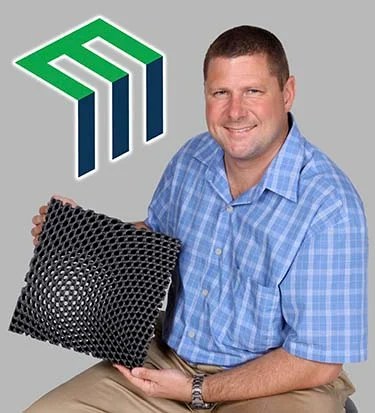
Dr. Raymond C. Rumpf has been promoted to Fellow of the International Society for Optics and Photonics (SPIE), an educational nonprofit established to advance light-based science, engineering, and technology.
Fellows are members of distinction who have made significant scientific and technical contributions in the multidisciplinary fields of optics, photonics, and imaging. They are honored for their technical achievement and their service to the general optics community and SPIE in particular.
Rumpf’s research is focused on developing revolutionary technologies in photonics, electromagnetics, and circuits that are enabled by digital manufacturing. His research team members at the University of Texas-El Paso are pioneers and leaders in the areas of hybrid additive manufacturing, electromagnetics, and photonics. Their research also includes 3D/volumetric circuits, metamaterials, photonic crystals, antennas, frequency selective surfaces, nanophotonics, devices for extreme environments and computational electromagnetics.
“My research group works on very unconventional and ambitious topics, so awards like this are very meaningful to me because it recognizes that our work has been truly significant and made an impact,” Rumpf said.
Rumpf’s work in spatially-variant lattices led him to discover new ways to control light. His team set a world record for the tightest bend of an optical beam and was awarded Best Photonics Technology in 2015 by Opli Magazine.